Showing posts with label writing. Show all posts

Thursday, April 7, 2011

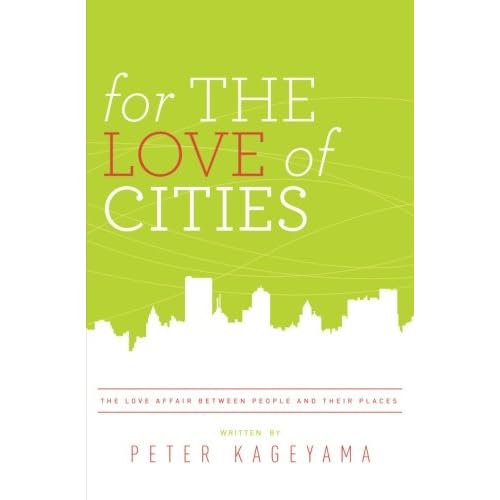
For the Love of Cities

For the Love of Cities: The love affair between people and their places, a new book by urbanist Peter Kageyama, explores the love affair between people and the places they call home.

Kageyama explores the emotional connection between citizens and their cities, honing in on how the human heart plays a role in economic, social adn community development. Drawing on examples from New Orleans, Detroit, and Cleveland, the book includes stories about ordinary people doing extraordinary things in the wake of the vacuum left behind by dwindling public resources.

Kageyama was interviewed today on the Craig Fahle Show (listen here), on WDET.  According to Kageyama, only 1% of the population are true "place lovers";  those who drive the agenda and invest their energies out of a true love of place.

"True love of place is kind of rare. ...  People who love cities are projecting something of themselves into the city. They want to make meaning in the city, and they are also looking at it as a work of art, they are co-creating the city," he told Fahle.

Kageyama will also be present at the Rust Belt Artists Belt III Conference taking place in Detroit April 6.

Wednesday, March 30, 2011

Midwestern Gothic

Midwestern Gothic is a new literary magazine out of Ann Arbor is focusing on the Midwest.  The mags goal is to "collect the very best in Midwestern writers and writing in an effort to compile a definitive resource on the region and its influences.

Prose, poetry and photography by those who live or have lived in the Midwest are sought, especially those that that capture the essence of the Midwest.

My favorite Detroit-area writer/blogger Anna Clark will be featured in the first issue.

Tuesday, January 4, 2011

Rumpus Readers on Neighborhood - The Rumpus.net

The Rumpus, a San Fransisco-based online literary and culture magazine co-founded by author Stephen Elliott, recently issued a call for reader submissions on the topic of neighborhood- 500 words or less.

As this post by NRDC's Kaid Bensfield so eloquently points out, neighborhoods, not cities, are the locus for defining our connection to place. They embody the spatial increments which circumscribe our daily existence and create (or preclude) the opportunities we have (or don't) for meeting the people who surround us.

Ray LaHood, Secretary for the US Department of Transportation, defines neighborhood this way.  Richard Florida has another take. According to Wendell Berry, local economies depend on them.

I have an ideal mental image of "neighborhood" and I am not sure that I have ever lived in one.  My first image derives, of course, from Sesame Street's "Who Are The People in Your Neighborhood."  I picture a bustling street with people milling about. I think of corner stores, neighborhood Christmas get-togethers, local eateries, dropping by, informal Friday night dinners at a friend's house, and "regulars".

I had a taste of this kind of neighborhood in college, in the student ghettoes of Ann Arbor, where on front porches festooned with decomposing couches, students congregated in impromptu, informal gatherings. I had another taste while visiting friends in Portland, Oregon, and again in Grand Rapids, Michigan.

Before and since those college years,  I have always lived in suburban, single-family residential "neighborhoods."  The one I live in now is nice.  I can walk to a downtown area in about ten minutes in one direction, and to a park with a river in the other. People are out walking dogs and kids  in the evenings when the weather is nice.

Yet I feel something is missing, something that I can't quite put my finger on.  I don't feel connected to the community.  I don't feel part of my neighborhood.

I am intent on finding ways to be more connected.

Here's what I've learned about living in the suburbs: you meet people in your job and through other interests, but because you spend so much time away from home or inside of your home, meeting your neighbors takes effort. And because everyone you know from the other parts of your life  (which take place in other land uses) live so far away, having a social life takes a lot of planning. And, of course, driving.

The Rumpus' readers delve into some of these themes with some delicate, beautiful writing. Here is a sampling:

Aimee Loselle writes on the ideologies we manufacture about our childhood neighborhoods:

I’ve never found the same sense of belonging I had when I was ten, running home on a July evening, tan and tired from playing tag and kill-the-man-with-the-ball, ready to eat meatloaf and read a book in my bedroom or watch “Private Benjamin” or “The Greatest American Hero” on television. My house was mostly silent by then, everyone in retreat. Yet the neighborhood streetlights and kitchen windows were seemingly stable and warm outside my own lit room. I fell for that illusion. I had to believe, even as it shredded around me. Although I don’t believe anymore, I still have the longing. For something unchanging and full of sentiment. For something that doesn’t exist.

Ray Shea contemplates the illusory, arbitrary borders we construct in our neighborhoods:

I’ve never been past the La Chica. It’s not a neighborhood I avoid, it’s just that it’s all houses and apartment buildings and I don’t know anybody who lives there. I only go to the edge, to the taco truck. I wish I spoke Spanish. I wish I could hang around and drink beer, talk to the men, while my children play in the parking lot. It feels nice.
Sam Jasperh satirizes the isolation that suburban neighborhoods can engender:
After two years’ residency, you can try sitting on your porch, which constitutes a breach of neighborhood etiquette, with a sign lettered: “Seeking friendship. Apply within.”
Find the local indie bookstore, drive the fifteen miles to it, park in the very large lot. Walk in and case the place, like you would if you were planning to rob it. Make small talk with the clerk. You’ll most likely be the only person in the place.
Joan Mathieu describes the crime and poverty of a skid row neighborhood, then points out:
But here’s the thing. Bank robbers and car thieves make better neighbors than doctors, lawyers, and TV actresses, the sort of people I once called neighbor before fortune blasted me against the rocks. Those people never came out of their houses, and when they did never spoke to me, and when they spoke to me it was to tell me to keep my fucking dog out of their yard.

Read more at:
Readers Report Back From… Neighborhood - The Rumpus.net:

Monday, October 4, 2010

PlaceLit: Rhonda Welsh

My Only Home

By Rhonda Welsh

Detroit is my only home.
Child of the west side...
Majestic, Puritan, Elmhurst,
Linwood, Plymouth, Eight Mile
All the while
craved a
different existence
but finally realized
Detroit is who I am.
Good students teased for acting too white
while the suburbs scream too black.
Neighborhoods who know no lack
always labeled poor.
Detroit was once much more than…
Dirty streets. Corrupt politicians.
Perverted superstitions
make some people treat books
like bad ju ju.
But my Detroit is not that simple…
Kind-hearted hustlers work day and night.
Make a dollar out of fifteen cents.
The auto industry came and went
but true Detroiters always make it work.
Saturday greens from Eastern Market
and a new hat from Mr. Song.
You can't go wrong on Sunday mornings
shouting and rocking
until the blues melt away.
Detroiters always seek
a brand new day.
Even our skyline boasts a Renaissance.
And the summer…
Caribbean Picnic on Belle Isle,
Moonlit concerts at Campus Martius,
and greasy fish fingers
clap to the beat
with sandal clad feet
at the African World Festival.
Poetry is everywhere.
Music Hall, Scarab Club, 1515 Broadway,
even at the Y-M-C-A.
Detroit is no longer in its heyday,
but its days are not finished yet.
There is much more life.
More pride runs through the veins.
Soon the activists must rise and take the reins.
Restore what has been lost.
No longer give thought
to those who diss and dismiss.
It is not a wasteland.
There are families here.
Educators, doctors, lawyers,
butchers, bakers,
yes, even candlestick makers reside in Detroit.
Shake off depleted self-esteem
that hangs over the city like a cloud.
Shout the city's praises out loud
and recognize its worth.
Induce the new birth.
Invoke that migrant spirit
transplanted from red earth.
Don't let it die an unnatural death.
Purge the dross and rebuild the best.
Detroit is the only home I've ever known.

©Rhonda Welsh 2010
from the book Red Clay Legacy


Read more: http://detroit.blogs.time.com/2010/10/04/a-detroit-poet-and-her-city-as-muse/?utm_source=feedburner&utm_medium=email&utm_campaign=Feed%3A+blogs%2Fthedetroitblog+%28TIME%3A+The+Detroit+Blog%29#ixzz11RTmgfLn

Saturday, August 14, 2010

PlaceLit

Anna Clark, an inspired writer and social activist from Detroit who I admire immensely, recently countered NPR's list of five books to help you escape with her own list of seven books that incorporate place as a critical component on her book blog, Isak.

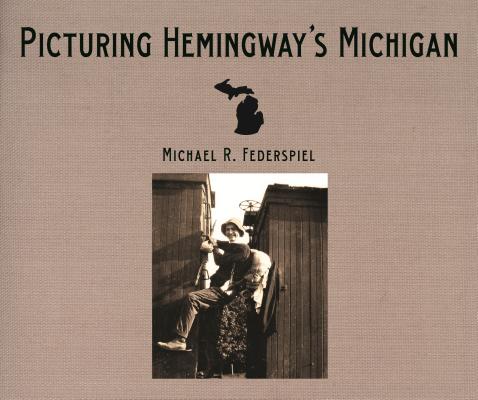
As I am writing this from Northern Michigan, I am psyched to see the NPR list includes Michael Felderspiel's Picturing Hemingway's Michigan from Wayne State University Press.

Tuesday, June 22, 2010

Letter from Detroit


I recently wrote a prose piece, Letter from Detroit, that was accepted for publication in two literary magazines- the online Glass Coin, and the July/August print version of Orion Magazine .

The piece reflects my feelings about my choice to remain in the Detroit Metropolitan area- the beauty and the struggle, the hope and the despair, which is inherent everywhere but is particularly stark in the Detroit area.

You can read my piece here, and submit your own to Orion's the Place Where You Live web feature.