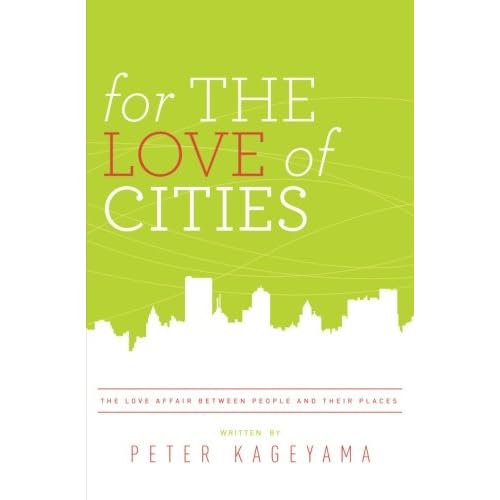
For the Love of Cities: The love affair between people and their places, a new book by urbanist Peter Kageyama, explores the love affair between people and the places they call home.
Kageyama explores the emotional connection between citizens and their cities, honing in on how the human heart plays a role in economic, social adn community development. Drawing on examples from New Orleans, Detroit, and Cleveland, the book includes stories about ordinary people doing extraordinary things in the wake of the vacuum left behind by dwindling public resources.
Kageyama was interviewed today on the Craig Fahle Show (listen here), on WDET. According to Kageyama, only 1% of the population are true "place lovers"; those who drive the agenda and invest their energies out of a true love of place.
"True love of place is kind of rare. ... People who love cities are projecting something of themselves into the city. They want to make meaning in the city, and they are also looking at it as a work of art, they are co-creating the city," he told Fahle.
Kageyama will also be present at the Rust Belt Artists Belt III Conference taking place in Detroit April 6.
Showing posts with label place. Show all posts
Thursday, April 7, 2011
Wednesday, March 30, 2011
Midwestern Gothic
Midwestern Gothic is a new literary magazine out of Ann Arbor is focusing on the Midwest. The mags goal is to "collect the very best in Midwestern writers and writing in an effort to compile a definitive resource on the region and its influences.
Prose, poetry and photography by those who live or have lived in the Midwest are sought, especially those that that capture the essence of the Midwest.
My favorite Detroit-area writer/blogger Anna Clark will be featured in the first issue.
Prose, poetry and photography by those who live or have lived in the Midwest are sought, especially those that that capture the essence of the Midwest.
My favorite Detroit-area writer/blogger Anna Clark will be featured in the first issue.
Wednesday, October 13, 2010
This Place Matters
This Place Matters is a program through the National Trust for Historic Preservation to create a central clearinghouse for places that matter to individual people. You can register at the site, upload photos of your special place to a group Flickr pool, geotag them in a community Google Map, and dowload a "This Place Matters sign to affix to your place.
The idea is similar to the Orion Magazine's The Place Where You Live web feature (also featured in the print magazine) which I have proudly written for.
Saturday, October 9, 2010
Place Samplings 10/9/2010
Better Burb Contest- "The time for thinking cautiously is over"
From the website:
There has been a crisis of imagination, and your bold new ideas are urgently needed. There should be no preconceptions about what is or is not possible. What would you do on these acres of opportunity? Build a car-free community for thousands? Plant an oasis of urban agriculture? Produce renewable energy and provide well-paying green jobs? Use landscape systems to repair ruptures in regional ecologies? Introduce armatures to enhance public space and the civic realm?
Other Links of Note:
From the website:
There has been a crisis of imagination, and your bold new ideas are urgently needed. There should be no preconceptions about what is or is not possible. What would you do on these acres of opportunity? Build a car-free community for thousands? Plant an oasis of urban agriculture? Produce renewable energy and provide well-paying green jobs? Use landscape systems to repair ruptures in regional ecologies? Introduce armatures to enhance public space and the civic realm?
Other Links of Note:
Obama Administration Rolls Out the Neighborhood Revitalization Initiative
Detroit
Labels:
Detroit,
Food,
health,
neighborhoods,
place,
suburbs,
sustainability
Wednesday, September 1, 2010
The Sun Magazine | Quiet, Please
The current issue of The Sun Magazine features an interview by Leslee Goodman with Gordon Hempton, listener, recorder and archivist of "natural soundscapes". According to Hempton, the natural sounds of our landscapes have been decimated; he believes there are only a few places in North America and none in Europe where one can avoid the sound of human activity for greater that twenty minutes. He leads a campaign to designate "one square inch" of silence in Olympic National Park, and has lobbied the FAA to designate a no-fly zone over the park.
In Hempton's words from the interview:
When people wonder whether they should take the time to pursue finding a silent place in nature, I often ask whether they’ve seen the Milky Way. Many have, but some haven’t. When I look up at the Milky Way, it never fails to impress me. What a difference there is between talking about the universe and looking up and actually witnessing the galaxy of which we’re a part — an ocean of stars so immense that, by comparison, the items on my ever-present to-do list shrink in significance, and I feel renewed awe and reverence.
Experiencing silence can be like that. In a naturally quiet place you can hear for miles. People who live in cities can often hear only a few hundred yards. In nature your sense of place is huge.
The Sun Magazine | Quiet, Please
Tuesday, February 16, 2010
Great Places in America
The American Planning Association's Great Places in America program celebrates some of the greatest places we have in this country- neighborhoods, streets, and public spaces. Michigan scored three places in 2009- Main Street Ann Arbor, Front Street Traverse City, and East Park, Charlevoix.
"APA Great Places offer better choices for where and how people work and live. They are enjoyable, safe, and desirable. They are places where people want to be — not only to visit, but to live and work every day. America's truly great streets, neighborhoods and public spaces are defined by many criteria, including architectural features, accessibility, functionality, and community involvement."
The deadline to nominate places for 2010 is February 25th!
Friday, January 29, 2010
Lost and Found: A Sense of Place
We live our lives in places; physical places like cities, towns, metropolitan areas, secret hiding places, nooks and crevices, while also inhabiting the non-physical places of our inner landscape: our emotions, consciousness, relationships, lifestyles and personal decisions. Physical place gives form, context, and structure to our inner, intangible space, impacting our relationships to one another, shaping and delimiting the sphere of our existence and experience.
To the extent that we are aware of and rooted in the outer and inner places that we inhabit, we achieve intimate connectedness and deep knowledge of the peculiarities and nuances and history of our selves and our surroundings, cultivating a sense of belonging and identification with ourselves and our location in the universe; a "sense of place."
You know it when you feel it. A sense of place is a sense that you are at home, somewhere special, authentic, and unique. A sense that there is nowhere else in the world quite like it, a feeling of connection to the details-species of trees, architecture, cuisine, music, local business, history, nuances of speech- the peculiarities that have co-evolved in one location to create the identity that sets a particular place apart.
Obstacles to establishing a sense of place in abound in our modern world: mobility, time constraints, and technology strain our ability to connect. The bland architecture and homogeneous community design pervading much of the landscape developed in the past 50 years leaves us less to connect with. I believe this loss of connection to place is tightly related to loss of connection to community, self, and spirit, and poses a serious threat to the health of individuals and society. When we lose these connections, we seek to fill the hole left in our lives. This seeking can be constructive (art, spirituality, community), or destructive (consumerism in all of its myriad forms).
To the extent that we are aware of and rooted in the outer and inner places that we inhabit, we achieve intimate connectedness and deep knowledge of the peculiarities and nuances and history of our selves and our surroundings, cultivating a sense of belonging and identification with ourselves and our location in the universe; a "sense of place."
You know it when you feel it. A sense of place is a sense that you are at home, somewhere special, authentic, and unique. A sense that there is nowhere else in the world quite like it, a feeling of connection to the details-species of trees, architecture, cuisine, music, local business, history, nuances of speech- the peculiarities that have co-evolved in one location to create the identity that sets a particular place apart.
Obstacles to establishing a sense of place in abound in our modern world: mobility, time constraints, and technology strain our ability to connect. The bland architecture and homogeneous community design pervading much of the landscape developed in the past 50 years leaves us less to connect with. I believe this loss of connection to place is tightly related to loss of connection to community, self, and spirit, and poses a serious threat to the health of individuals and society. When we lose these connections, we seek to fill the hole left in our lives. This seeking can be constructive (art, spirituality, community), or destructive (consumerism in all of its myriad forms).
All around me, I am observing efforts to re-establish and reconnect ourselves with place, and I believe these efforts are signs that as humans, we recognize the need to know where we are, and to have a place to call home. This is what I want to focus on in this space.
Place hopes to address and explore the following:
- What is the role of place in our lives?
- How do the kinds of places we live in shape the events we encounter, our outlooks, our opportunities?
- How and where are people connecting with place today?
- How do place and technology interact?
- How do we connect to place in our increasingly mobile world?
- How does place impact the nature of individuals, families, communities?
Although Place is about place as a concept and will not strictly be about Metropolitan Detroit, as a native and resident my perspective and information will certainly be colored by my attachment to this particular place, with all of its attendant beauty and tribulations.
Subscribe to:
Posts (Atom)