Showing posts with label urbanism. Show all posts

Thursday, April 7, 2011

For the Love of Cities

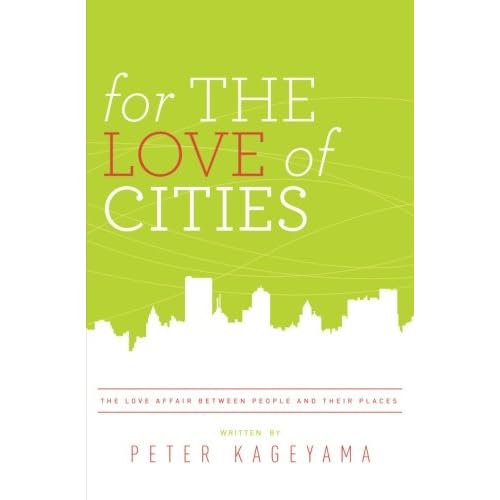
For the Love of Cities: The love affair between people and their places, a new book by urbanist Peter Kageyama, explores the love affair between people and the places they call home.

Kageyama explores the emotional connection between citizens and their cities, honing in on how the human heart plays a role in economic, social adn community development. Drawing on examples from New Orleans, Detroit, and Cleveland, the book includes stories about ordinary people doing extraordinary things in the wake of the vacuum left behind by dwindling public resources.

Kageyama was interviewed today on the Craig Fahle Show (listen here), on WDET.  According to Kageyama, only 1% of the population are true "place lovers";  those who drive the agenda and invest their energies out of a true love of place.

"True love of place is kind of rare. ...  People who love cities are projecting something of themselves into the city. They want to make meaning in the city, and they are also looking at it as a work of art, they are co-creating the city," he told Fahle.

Kageyama will also be present at the Rust Belt Artists Belt III Conference taking place in Detroit April 6.

Wednesday, December 22, 2010

The Laws of Place


Image Source: New York Times

A fascinating article in last weekend's New York Times Magazine explores the work of Geoffrey West, a physicist who has constructed mathematical models to describe cities based on constants developed through statistical analysis of urban data from all over the world. 

Given, for example, the number of people in a city, West's models can predict the amount and dimensions of variables such as infrastructure and average income level.

Urbanists may take issue with such a  reductive approach to urban theory- after all, cities and place are about culture, nuance, history.  

To which West responds:
"That’s all we talk about when we talk about cities, those things that make New York different from L.A., or Tokyo different from Albuquerque. But focusing on those differences misses the point. Sure, there are differences, but different from what? We’ve found the what.”
Which has me wondering: are there two points here to be acknowledged; (1) that humans and our habitats are structurally similar but (2) uniquely colored by the beauty and nuance of our individual and collective spirit? And which is the more important "point"; or are they two sides of the same coin of our human experience?


West's work provides quantitative backbone to the ideas of Jane Jacobs, who, in her seminal work The Death and Life of Great American Cities, posited the idea that the value of cities lies in their facilitation of human interaction which results in enhancement of opportunities for collaboration and, ultimately, productivity.  West's models show that for every doubling in population within an urban area, a 15% per capita increase in productivity results.


From the article:
“One of my favorite compliments is when people come up to me and say, ‘You have done what Jane Jacobs would have done, if only she could do mathematics,’ ” West says. “What the data clearly shows, and what she was clever enough to anticipate, is that when people come together, they become much more productive.”

This aspect of cities was brought home to me recently via a comment from a friend who has departed the suburbs of Detroit for  life in Seattle. She spoke of the  difficulty of seeing old friends in the Detroit metro area while visiting because the extensive driving involved,  often 30-40 minutes, require so much advance planning.  Chance encounters and last-minute meet-ups at the corner bar are nearly unheard of. 


By living in cities, we have decoupled the linear relationship between growth and productivity that governs biology.  Of course, the increase in productivity is predicated on the assumption of endless resources, and will eventually bump up against the planet's carrying capacity.  West coins a unique metaphor for our resource consumption. So long, carbon footprint; hello blue whales:


From the article:
West illustrates the problem by translating human life into watts. “A human being at rest runs on 90 watts,” he says. “That’s how much power you need just to lie down. And if you’re a hunter-gatherer and you live in the Amazon, you’ll need about 250 watts. That’s how much energy it takes to run about and find food. So how much energy does our lifestyle [in America] require? Well, when you add up all our calories and then you add up the energy needed to run the computer and the air-conditioner, you get an incredibly large number, somewhere around 11,000 watts. Now you can ask yourself: What kind of animal requires 11,000 watts to live? And what you find is that we have created a lifestyle where we need more watts than a blue whale. We require more energy than the biggest animal that has ever existed. That is why our lifestyle is unsustainable. We can’t have seven billion blue whales on this planet. It’s not even clear that we can afford to have 300 million blue whales.”