Showing posts with label urban ag. Show all posts

Friday, October 22, 2010

Detroit: Urban Agriculture Tour

Finished up the Michigan Association of Planning's annual conference today with a great tour, and met some pretty fascinating Detroit people who are doing amazing things,.

Japanese journalists film us touring D-Town farm
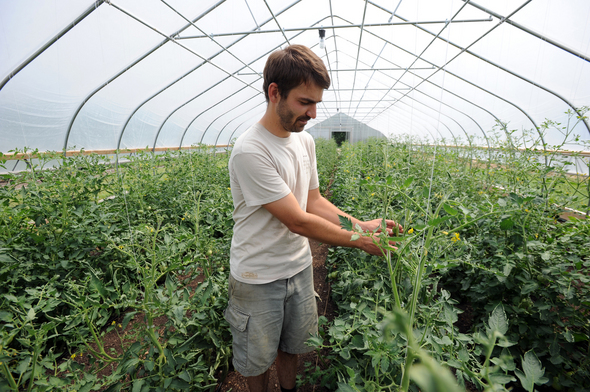
In the morning we headed over to D-Town Farm, run by the Detroit Black Food Security Network on land in Detroit's Rouge Park.  The land is  leased from the City of Detroit for $1/year for 10 years.  Our host, Malik Yakini, chairman of the DBFSN as well as a Detroit Charter School principal, gave us a tour and an explanation of the DBFSN as well as the context in which it is doing its work.  The goal of D-Town farm is to create a model for urban agriculture and to achieve food security for Detroit's black population. D-Town sells produce at Eastern Market, other Farmer's markets in the City, and several restaurants.

Yakini says he is unapologetic about the intent of the DBFSN to advance black power and expressed the local grassroots movements' opposition to large-scale urban agriculture within City limits that does not have the interests of the community in mind.  We also discussed food policy issues; Yakini is on the Michigan Food Policy Council and is working to help develop policy within the city and at the state level that will help community-scale urban agriculture.

While we were there, Japanese journalists filmed our tour for a TV station, and a French radio reporter showed up, wanting to interview Yakini, who seemed used to the attention this project and others like it is garnering on the international stage.
Gwen, who came to Earthworks Urban Farm from Nebraska
 through Americorps

EarthWorks Urban Farm
Next we visited Earthworks Urban Farm, a project of the Capuchin monastery in partnership with Gleaners Food Bank, which has been in operation for ten years. Our tour host, Gwen, came to the Farm via an Americorps assignment and has stayed on through the end of this growing season.  She spoke of the need to engage the local African-American community in urban agriculture, noting that the movement is often led by young, white transplants. The Capuchin program trains local neighborhood residents in farming and gardening, and utilizes the produce in the soup kitchen, which serves neighborhood residents in need..

Sunday, August 1, 2010

St. Joseph Mercy Ann Arbor returns to its farming roots by using hospital land to grow produce - AnnArbor.com

More urban farming! This time at a hospital: St. Joseph Mercy Ann Arbor.
From annarbor.com:


"St. Joe is in the midst of Phase 1 of a project to farm up to 30 acres of its campus. The hospital began planting produce — things like tomatoes and peppers — in April, and is beginning to harvest it for sale to staff, patients and the general public."


St. Joseph Mercy Ann Arbor returns to its farming roots by using hospital land to grow produce - AnnArbor.com

Image Source: annarbor.com

Saturday, July 31, 2010

The Urbanophile's Detroit Post

The Urbanophile, one of my favorite urban planning blogs, recently re-posted it's most popular post ever.

The post, which ran originally in 2009, is on Detroit, and gives a pretty good synopsis of where things stood in 2009.  I am not sure much has changed since the original post..

All of this national media interest initiated  in 2008 when the national spotlight shone on the collapsing auto-industry. Time's Detroit Blog, Dateline's infamous piece and many other media pieces have put a magnifying glass on the City. The suburbs have escaped notice.

Now two years later, I wonder how long it will last. .

There are some pretty great Detroit bloggers out there.  Here is one of my favorites; I have a feeling this guy will be writing when and if the national spotlights fade:

http://bbandm.wordpress.com/

Monday, July 19, 2010

HAVEN Garden Project

Urban agriculture isn't just about Detroit and Flint.  I was excited to learn recently about the garden project at HAVEN, a domestic violence shelter located in the City of Pontiac.   The project, which seeks to produce food for consumption by HAVEN residents and the community, was launched this past April by a coalition of community members and urban agriculture activists.


The Michigan Young Farmers Coalition, founded by MSU senior horticulture student Benjamin Gluck, is taking a leadership role in the project, along with Alexis Bogdanova-Hanna of Abundant Succession, an urban agriculture consulting and education form, and women’s health website  AskInYourFace.com founder Allison Stuart Kaplan.  Community residents and schools provide additional support to the project. The harvest thus far has exceeded all expectations. Bogdanova-Hanna writes on AskInYourFace.com :

Since the initial planting in mid-April, the HAVEN Garden has been growing abundantly and beyond all expectations. Perhaps it’s the infusion of love and care from the HAVEN Community, the careful execution of an innovative crop plan, or the swell of support from generous donors that has brought us to the point of surplus and success. More likely, it is a combination of all of these – the perfect mix of the tangible (remay row covers) and the intangible (synergistic energy). Whatever it is, it’s working.
A notable success of the project has been the creation of a job for local Pontiac resident Aaron Kyle. Kyle, who has no prior horticultural experience, manages the daily operations of the garden, building technical and leadership skills in the process. 


Read more about the project here and here, and view pictures here.

Friday, April 23, 2010

GOOD Magazine The Neighborhood Issue


New to me is GOOD Magazine, which has been around since 2006. GOOD is a quarterly concern which focuses on good ideas, and covers business, cities, culture, design, education, environment, food, health, media, politics, technology, and transportation. The website includes a forum where readers can contribute and engage.

The current issue focuses on neighborhoods, bringing together a lot of urban planning theory and common-sense good ideas to create a graphically beautiful, engaging piece. The volume includes a "Good Guide to Better Neighborhoods" includes twelve ideas, including the standard (plant a community garden, throw a block party),  novel (create a neighborhood clubhouse, find a third place), and timely ideas (squatting in a foreclosed home).

I highly recommend the issue, website and blog.

Issue 019 - GOOD Magazine - GOOD

Monday, April 5, 2010

A Ten Year Vision for Detroit

The Freep's Sunday Editorial section featured a spread summarizing various items coming  together to deliver a  "smaller, smarter, greener" city in ten years. Mitch Albom's poetic piece begins:
"In my Detroit, a decade from now, there are no blocks with one burned-out house. Those eyesores have been leveled. Grass and trees have taken their place."
I would have liked to see a few additions to Albom's column and to the featured map (which should not have yellowed out the suburbs and Windsor, Canada.

I would add the following:

In my Detroit, the hundreds of autonomous suburban municipalities and school districts have merged services to become more efficient and effective.


In my Detroit, the City and every suburb have adopted and implemented sustainability plans which outline how they are going to reduce greenhouse gases, conserve water, create and preserve green infrastructure, and reduce solid waste.

In my Detroit, Belle Isle has been restored to its former grandeur, and the Belle Isle Aquarium has been re-opened and expanded, featuring top-notch exhibits and programs about the Great Lakes and the Detroit River.


In my Detroit, the City and suburbs collaborate and cooperate because they know it is in their mutual best interest to do so.

Saturday, March 27, 2010

Downsizing Detroit


Can Detroit be downsized?  Can the vast tracts of land now featuring vacant, abandoned neighborhoods be transformed into orchards, pumpkin patches, cornfields, and vegetable gardens?  Can neighborhoods be consolidated? And will this, in the end, do anything to alleviate the generational poverty that has afflicted the remaining citizens of Detroit since the 1960's?

I am optimistic about this for several reasons:

1. Foundations in the area are coordinating efforts and leveraging resources with an emphasis on Detroit. Kresge Foundation is paying the salary for an outside urban planner to work with City Council to develop the downsizing plan. The foundations have historically worked piecemeal and independently.  This synergy must extend to the public and private sectors in order to avoid the same types of problems that have plagued government-led efforts in the past..

2. Local and organic food is a big deal. Even mid-level chain grocery stores such as Kroger are advertising sourcing of local products.  Done right,  there is unprecedented potential for local agriculture to be profitable.

3. Unlike earlier economic development schemes (think: casinos) the concepts of downsizing and urban farming are not designed to create thousands of jobs and enrich investors and developers.  Instead, downsizing is a rational response to existing conditions, and urban agriculture identifies a viable use for the city's main asset: land. No one will get rich, but maybe a stable and productive industry will lift some out of poverty. And unlike gambling, there is no societal cost to community gardens.