Sunday, November 27, 2011

The New American Dichotomy According to Richard Florida: The "Stuck" and the Mobile

Source: http://www.theatlanticcities.com/housing/2011/11/geography-stuck/534/
Is anyone still taking Richard Florida's simplistic, self-reverential tripe seriously?

And more importantly, why is Atlantic Cities,  an otherwise admirable project to provide an outlet for contemporary American urban thought and criticism, still publishing it?

Admittedly, Florida was able to discern and accurately describe an important trend- that what he coined the "Creative Class" (or the young, tech-savvy, mobile and creative demographic) is an important economic driver in some places, and that by considering the needs and desires of this subgroup,  a legitimate approach to economic development, one beyond chasing large companies with tax abatements, might be found.

But.

He has long since gone too far, writing off broad swaths of the country as economic losers incapable of ever attracting the mobile, creative types which are, in his view, the sole path to future prosperity.   A 2009 American Prospect article, "The Ruse of the Creative Class" deftly shines a bright light on the many holes, contradictions and shortcomings of his arguments:
A tautology lies at the heart of Florida's theory that has limited its instructive value all along: Creative people seek out places that draw a lot of creative people. Florida has now taken this closed-loop argument to another level by declaring that henceforth, the winners' club is closed to new entrants.
By pegging the economic hope of the future on a single narrowly defined demographic subgroup,  he has discounted not only most places, but most people.

And now, in a breathtakingly overly simplistic analysis of state-level census data showing the percent born in their state of residence, Florida has created a new American dichotomy- the "mobile" vs. the "stuck" to serve as evidence for his views:
America can be divided into two distinct classes, the stuck and the mobile. The mobile possess the resources and the inclination to seek out and move to locations where they pursue economic opportunity. Too many Americans are stuck in places with limited resources and opportunities. This geography of the stuck and mobile is a key axis of cleavage in the United States.
Let's not even begin to attempt to define the meaning of "axis of cleavage."

It's hard to know what conclusions to draw from this map.  Florida reads it this way: states with high percentages of native-born residents (primarily the midwest) are centers of the talentless and uncreative: the "stuck." Those with low percentages (the coasts and the Rocky Mountain states) are magnets for the creative, talented "mobile."

Maybe.

But the coasts have long been the first point of immigration from other countries and the destination of recent college grads- many of whom eventually end up settling in or returning to the more affordable midwest.  Not a new story.

And yes, clearly the midwest has lost population with the decline of manufacturing.

But does that mean all or most of it's remaining residents are "stuck?"

What about those who choose to stay in or return to their native-born state, who weigh the tradeoff between a higher cost of living far from family, and an affordable one with friends and family nearby, and decide that staying put makes sense?  Do they lack talent and drive? Are they "stuck?"

What about those who are invested in a place, who have deep roots and care about their community, who know who they are and where they come from? What about those with economic connections- a family business-  or emotional connections-  a family history?  Do they lack some creative gene, dooming them to economic and cultural doldrums?

I wonder about the long-term sustainability of places like San Diego, Seattle, Boston and Portland, places well-known for catering to particular demographic characteristics and lifestyle preferences.

I wonder about places where no one has parents.

I wonder about a "class" of people defined primarily by their mobility; their willingness to surrender their roots, to move from place to place in pursuit of the next big thing.

Scott Russell Sanders in Staying Put: Making A Home in a Restless World writes:
For me, the effort of being grounded in family and community is inseparable from the effort of being grounded in place.
On the flip side of mobility, maybe there is economic value in a willingness and ability to settle down and be grounded in a particular place, and to commit to making that place better.

Maybe we need both "classes" to build an economic future that is both dynamic and stable.

And perhaps we can coin a better dichotomy.

Maybe they are not the "stuck."

Maybe they are the rooted.


Thursday, October 6, 2011

Crowdsourcing Your Favorite Public Space

San Francisco's Grand View Park. 
Photo: Shawn Calhoun.
Planetizen is crowdsourcing the top 100 public spaces on Ideascale.


Each user gets 15 chips to spend how you like on voting for your favorite public space. Most spots with the high votes are on the east and west coasts.

I spent mine as follows


1 chip on Campus Martius Park
5 chips on Sleeping Bear Dunes National Lakeshore
1 chip on Yosemite Valley, Yosemite National Park
1 chip on  Huron Clinton Metroparks

And I submitted a new place, my favorite place of all time, Detroit Eastern Market.


Wednesday, October 5, 2011

APA has released the 2011 selections for Great Place, including Public Spaces, Streets, and Neighborhoods.

What makes a "great place"?  Read APA's selection criteria for Neighborhoods, Public Spaces, and Streets.

The common denominators: great places are those  places scaled for and used by people while respecting their context, history and heritage.


Friday, July 15, 2011

Call for Submissions: In Her Place

In what ways does being female affect one’s sense of place, placement, and/or (dis)location?  Submit essays of up to 300 words:

http://inherplace.org/


Thursday, April 7, 2011

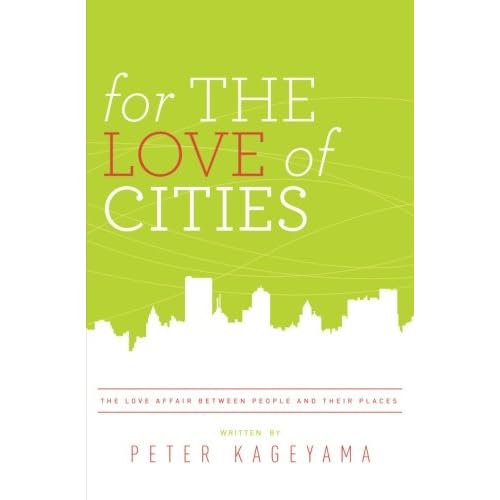
For the Love of Cities

For the Love of Cities: The love affair between people and their places, a new book by urbanist Peter Kageyama, explores the love affair between people and the places they call home.

Kageyama explores the emotional connection between citizens and their cities, honing in on how the human heart plays a role in economic, social adn community development. Drawing on examples from New Orleans, Detroit, and Cleveland, the book includes stories about ordinary people doing extraordinary things in the wake of the vacuum left behind by dwindling public resources.

Kageyama was interviewed today on the Craig Fahle Show (listen here), on WDET.  According to Kageyama, only 1% of the population are true "place lovers";  those who drive the agenda and invest their energies out of a true love of place.

"True love of place is kind of rare. ...  People who love cities are projecting something of themselves into the city. They want to make meaning in the city, and they are also looking at it as a work of art, they are co-creating the city," he told Fahle.

Kageyama will also be present at the Rust Belt Artists Belt III Conference taking place in Detroit April 6.

Wednesday, March 30, 2011

Midwestern Gothic

Midwestern Gothic is a new literary magazine out of Ann Arbor is focusing on the Midwest.  The mags goal is to "collect the very best in Midwestern writers and writing in an effort to compile a definitive resource on the region and its influences.

Prose, poetry and photography by those who live or have lived in the Midwest are sought, especially those that that capture the essence of the Midwest.

My favorite Detroit-area writer/blogger Anna Clark will be featured in the first issue.

Sunday, March 13, 2011

Fringe- Places that Verb Your World


5 Pieces by R. Justin Stewart by R. Justin Stewart  03.07.2011

Fringe Magazine
Fringe Magazine, in honor of the launch  of Issue No. 26:  Maps (Spring '11), is asking readers to contribute to a piece of collaborative artwork, in the form of a Google Map:


For our anniversary Maps issue, Fringe is making an interactive map of Places That Verb Your World and we need help. Send a little something — a photograph, a verse, a few sentences about a geographical location that is meaningful to you - to FringeTheMagazine@gmail.com, or post your submissions on our Facebook page.

Quite a  few entries are up already. Viewed using the Google Maps plug-in, you can fly from place to place and view these places-from-the-heart from the landscape level or street level, accompanied by verse, a short story, or a photo.

Tuesday, January 4, 2011

Rumpus Readers on Neighborhood - The Rumpus.net

The Rumpus, a San Fransisco-based online literary and culture magazine co-founded by author Stephen Elliott, recently issued a call for reader submissions on the topic of neighborhood- 500 words or less.

As this post by NRDC's Kaid Bensfield so eloquently points out, neighborhoods, not cities, are the locus for defining our connection to place. They embody the spatial increments which circumscribe our daily existence and create (or preclude) the opportunities we have (or don't) for meeting the people who surround us.

Ray LaHood, Secretary for the US Department of Transportation, defines neighborhood this way.  Richard Florida has another take. According to Wendell Berry, local economies depend on them.

I have an ideal mental image of "neighborhood" and I am not sure that I have ever lived in one.  My first image derives, of course, from Sesame Street's "Who Are The People in Your Neighborhood."  I picture a bustling street with people milling about. I think of corner stores, neighborhood Christmas get-togethers, local eateries, dropping by, informal Friday night dinners at a friend's house, and "regulars".

I had a taste of this kind of neighborhood in college, in the student ghettoes of Ann Arbor, where on front porches festooned with decomposing couches, students congregated in impromptu, informal gatherings. I had another taste while visiting friends in Portland, Oregon, and again in Grand Rapids, Michigan.

Before and since those college years,  I have always lived in suburban, single-family residential "neighborhoods."  The one I live in now is nice.  I can walk to a downtown area in about ten minutes in one direction, and to a park with a river in the other. People are out walking dogs and kids  in the evenings when the weather is nice.

Yet I feel something is missing, something that I can't quite put my finger on.  I don't feel connected to the community.  I don't feel part of my neighborhood.

I am intent on finding ways to be more connected.

Here's what I've learned about living in the suburbs: you meet people in your job and through other interests, but because you spend so much time away from home or inside of your home, meeting your neighbors takes effort. And because everyone you know from the other parts of your life  (which take place in other land uses) live so far away, having a social life takes a lot of planning. And, of course, driving.

The Rumpus' readers delve into some of these themes with some delicate, beautiful writing. Here is a sampling:

Aimee Loselle writes on the ideologies we manufacture about our childhood neighborhoods:

I’ve never found the same sense of belonging I had when I was ten, running home on a July evening, tan and tired from playing tag and kill-the-man-with-the-ball, ready to eat meatloaf and read a book in my bedroom or watch “Private Benjamin” or “The Greatest American Hero” on television. My house was mostly silent by then, everyone in retreat. Yet the neighborhood streetlights and kitchen windows were seemingly stable and warm outside my own lit room. I fell for that illusion. I had to believe, even as it shredded around me. Although I don’t believe anymore, I still have the longing. For something unchanging and full of sentiment. For something that doesn’t exist.

Ray Shea contemplates the illusory, arbitrary borders we construct in our neighborhoods:

I’ve never been past the La Chica. It’s not a neighborhood I avoid, it’s just that it’s all houses and apartment buildings and I don’t know anybody who lives there. I only go to the edge, to the taco truck. I wish I spoke Spanish. I wish I could hang around and drink beer, talk to the men, while my children play in the parking lot. It feels nice.
Sam Jasperh satirizes the isolation that suburban neighborhoods can engender:
After two years’ residency, you can try sitting on your porch, which constitutes a breach of neighborhood etiquette, with a sign lettered: “Seeking friendship. Apply within.”
Find the local indie bookstore, drive the fifteen miles to it, park in the very large lot. Walk in and case the place, like you would if you were planning to rob it. Make small talk with the clerk. You’ll most likely be the only person in the place.
Joan Mathieu describes the crime and poverty of a skid row neighborhood, then points out:
But here’s the thing. Bank robbers and car thieves make better neighbors than doctors, lawyers, and TV actresses, the sort of people I once called neighbor before fortune blasted me against the rocks. Those people never came out of their houses, and when they did never spoke to me, and when they spoke to me it was to tell me to keep my fucking dog out of their yard.

Read more at:
Readers Report Back From… Neighborhood - The Rumpus.net:

Wednesday, December 22, 2010

The Laws of Place


Image Source: New York Times

A fascinating article in last weekend's New York Times Magazine explores the work of Geoffrey West, a physicist who has constructed mathematical models to describe cities based on constants developed through statistical analysis of urban data from all over the world. 

Given, for example, the number of people in a city, West's models can predict the amount and dimensions of variables such as infrastructure and average income level.

Urbanists may take issue with such a  reductive approach to urban theory- after all, cities and place are about culture, nuance, history.  

To which West responds:
"That’s all we talk about when we talk about cities, those things that make New York different from L.A., or Tokyo different from Albuquerque. But focusing on those differences misses the point. Sure, there are differences, but different from what? We’ve found the what.”
Which has me wondering: are there two points here to be acknowledged; (1) that humans and our habitats are structurally similar but (2) uniquely colored by the beauty and nuance of our individual and collective spirit? And which is the more important "point"; or are they two sides of the same coin of our human experience?


West's work provides quantitative backbone to the ideas of Jane Jacobs, who, in her seminal work The Death and Life of Great American Cities, posited the idea that the value of cities lies in their facilitation of human interaction which results in enhancement of opportunities for collaboration and, ultimately, productivity.  West's models show that for every doubling in population within an urban area, a 15% per capita increase in productivity results.


From the article:
“One of my favorite compliments is when people come up to me and say, ‘You have done what Jane Jacobs would have done, if only she could do mathematics,’ ” West says. “What the data clearly shows, and what she was clever enough to anticipate, is that when people come together, they become much more productive.”

This aspect of cities was brought home to me recently via a comment from a friend who has departed the suburbs of Detroit for  life in Seattle. She spoke of the  difficulty of seeing old friends in the Detroit metro area while visiting because the extensive driving involved,  often 30-40 minutes, require so much advance planning.  Chance encounters and last-minute meet-ups at the corner bar are nearly unheard of. 


By living in cities, we have decoupled the linear relationship between growth and productivity that governs biology.  Of course, the increase in productivity is predicated on the assumption of endless resources, and will eventually bump up against the planet's carrying capacity.  West coins a unique metaphor for our resource consumption. So long, carbon footprint; hello blue whales:


From the article:
West illustrates the problem by translating human life into watts. “A human being at rest runs on 90 watts,” he says. “That’s how much power you need just to lie down. And if you’re a hunter-gatherer and you live in the Amazon, you’ll need about 250 watts. That’s how much energy it takes to run about and find food. So how much energy does our lifestyle [in America] require? Well, when you add up all our calories and then you add up the energy needed to run the computer and the air-conditioner, you get an incredibly large number, somewhere around 11,000 watts. Now you can ask yourself: What kind of animal requires 11,000 watts to live? And what you find is that we have created a lifestyle where we need more watts than a blue whale. We require more energy than the biggest animal that has ever existed. That is why our lifestyle is unsustainable. We can’t have seven billion blue whales on this planet. It’s not even clear that we can afford to have 300 million blue whales.”

Friday, October 22, 2010

Detroit: Urban Agriculture Tour

Finished up the Michigan Association of Planning's annual conference today with a great tour, and met some pretty fascinating Detroit people who are doing amazing things,.

Japanese journalists film us touring D-Town farm
In the morning we headed over to D-Town Farm, run by the Detroit Black Food Security Network on land in Detroit's Rouge Park.  The land is  leased from the City of Detroit for $1/year for 10 years.  Our host, Malik Yakini, chairman of the DBFSN as well as a Detroit Charter School principal, gave us a tour and an explanation of the DBFSN as well as the context in which it is doing its work.  The goal of D-Town farm is to create a model for urban agriculture and to achieve food security for Detroit's black population. D-Town sells produce at Eastern Market, other Farmer's markets in the City, and several restaurants.

Yakini says he is unapologetic about the intent of the DBFSN to advance black power and expressed the local grassroots movements' opposition to large-scale urban agriculture within City limits that does not have the interests of the community in mind.  We also discussed food policy issues; Yakini is on the Michigan Food Policy Council and is working to help develop policy within the city and at the state level that will help community-scale urban agriculture.

While we were there, Japanese journalists filmed our tour for a TV station, and a French radio reporter showed up, wanting to interview Yakini, who seemed used to the attention this project and others like it is garnering on the international stage.
Gwen, who came to Earthworks Urban Farm from Nebraska
 through Americorps

EarthWorks Urban Farm
Next we visited Earthworks Urban Farm, a project of the Capuchin monastery in partnership with Gleaners Food Bank, which has been in operation for ten years. Our tour host, Gwen, came to the Farm via an Americorps assignment and has stayed on through the end of this growing season.  She spoke of the need to engage the local African-American community in urban agriculture, noting that the movement is often led by young, white transplants. The Capuchin program trains local neighborhood residents in farming and gardening, and utilizes the produce in the soup kitchen, which serves neighborhood residents in need..

Thursday, October 21, 2010

Planners in Detroit

Art Installation, Powerhouse Project, Hamtramck

Art Installation, Powerhouse Project, Hamtramck
I'm having a GREAT time at the Michigan Association of Planning's annual conference held in Detroit this year. Yesterday I attended a session with Philip Cooley, part owner of Slows Bar b Q  and Corktown booster, on why he came to Detroit and efforts to rebuild the neighborhood and Roosevelt Park at the foot of Detroit's greatest ruin.

This morning we heard from starchitect/star urban planner Toni Griffin and City of Detroit Deputy Planning Director Marja Winters on Detroit's much publicized, philanthropically-funded land use planning process, Detroit Works.

In the afternoon I attended a FANTASTIC tour of the City of Hamtramck, which I had not visited since high school when we hung out at Paychecks lounge.  Who knew- Hamtramck has retained it's density and walkability and is now an urban oasis amid the devastation of the surrounding City of Detroit.

The Polish population that founded the town in the 1920's is still present, comprising about 30-40% of the population, and has been supplemented by hardworking, entrepreneurial immigrants from Bangladesh and other countries.

It is fascinating to see these newcomers repeat the pattern of the Eastern and Southern Europeans of 100 years ago- they first land in New York, then come to Detroit for the cheaper cost of living, and start businesses.  Once they have gained financial stability, some move to the inner-ring suburbs, such as Warren, while others stay in the City.

Highlights of the tour included the Powerhouse Project,  a program to place national artists in residencies within an underserved Hamtramck neighborhood,  the Detroit Zen Center, which has been in existence since the 1990's and is working to create a neighborhood-scale sustainability model, and  the Polish Art Center, a purveyor and teacher of Polish folk art.

Tomorrow I am looking forward to Urban Agriculture Tour.

Thursday, October 14, 2010

To Know a Place: Terrain.org

Image: Terrain.org
The new issue of Terrain.org: A Journal of the Natural and Built Environments was launched yesterday, and I am just diving in. I am so impressed with how this online literary magazine devoted to "searching for that interface—the integration—among the built and natural environments, that might be called the soul of place" utilizes the tools of the internet to bring a multimedia experience that goes far beyond what one can experience in a print journal, and by the same token exceeds the experience afforded by most online literary journals.


Take Sara Loewan's breathtaking essay, Setnet Fishing in Uyak Bay, describing the summer fishing grounds she inhabits with her family on Kodiak Island, Alaska. The piece is for the issue's "To Know a Place" feature, which selects a story, essay or poem that "demonstrates an eloquent intimacy between an author and the author's place". 


Not only is Loewan's gorgeous prose featured, but the journal includes a beautiful photo essay, a Google map of the location, and an audio stream of the author reading the essay.


Loewan writes:


We catch sea cucumbers when they tangle with kelp in the lead lines of our salmon nets. In the skiff, they heave their guts out as a defense mechanism and wriggle away so that predators will eat the feathery pink insides and leave the sea cucumber to grow new innards. These animals were traditionally harvested during minus tides by hand or with spears tied to long poles.
My husband cooks the strips in olive oil. The meat tastes sweet and brackish. I think of the care and labor to produce these small crisp bites and it seems that food, as much as landscape, connects us to the people who first chose this place.

Beautiful.  I can't wait to delve further. 

Wednesday, October 13, 2010

This Place Matters

This Place Matters is a program through the National Trust for Historic Preservation to create a central clearinghouse for places that matter to individual people.  You can register at the site, upload photos of your special place to a group Flickr pool, geotag them in a community Google Map, and dowload a "This Place Matters sign to affix to your place.

The idea is similar to the Orion Magazine's The Place Where You Live web feature (also featured in the print magazine) which I have proudly written  for.

Tuesday, October 12, 2010

The Case for Suburban Renewal

Richard Florida in the Wall Street Journal:

Remaking America's sprawling suburbs, with their enormous footprints, shoddy construction, hastily built infrastructure and dying malls, is shaping up to be the biggest urban revitalization challenge of modern times—far larger in scale, scope and cost than the revitalization of our inner cities.

The Case for Suburban Renewal - WSJ.com

UPDATE: HERE is the unedited version.

Here are some resources on retrofitting the suburbs for sustainability and livability.

Monday, October 11, 2010

The Only Real Option is Beauty

Fascinating interview with designer Bruce Mau, courtesy of The Climate Desk, a collaboration of Mother Jones,SlateWiredThe AtlanticPBS’s Need to KnowReuters, Grist, and the Center for Investigative Reporting.


His arguments: suburbs are evolving, they are wildly successful so we have to work with them, it is possible to have a beautiful life experience in a low-density environment.  We need to reframe the sustainability discussion to make it positive, emphasize opportunities, and inspire people to live and work in a new way that is more compelling and more meaningful than the old way.

Saturday, October 9, 2010

Place Samplings 10/9/2010

Better Burb Contest- "The time for thinking cautiously is over"
From the website: 
There has been a crisis of imagination, and your bold new ideas are urgently needed. There should be no preconceptions about what is or is not possible. What would you do on these acres of opportunity? Build a car-free community for thousands? Plant an oasis of urban agriculture? Produce renewable energy and provide well-paying green jobs? Use landscape systems to repair ruptures in regional ecologies? Introduce armatures to enhance public space and the civic realm?


Other Links of Note:

Obama Administration Rolls Out the Neighborhood Revitalization Initiative


Detroit

Thursday, October 7, 2010

The Skies Here Are Bigger Than In New York

David Byrne of Talking Heads fame wrote a lengthy journal entry on his impression of the Motor City. Nothing much new here, but this was interesting:


“Are there other towns that have been hit so hard that have come back?” Both Michael Morris of Artangel and I replied “Glasgow”. It was known as having the worst slums in Europe back in the day, and I remember visiting my grandparents and all the buildings were grimy black, from soot. That city hasn’t come back as an industrial powerhouse it once was (steel and shipbuilding) but as a cultural hub. Life is good there now, and the city is cleaned up and nice to look at.
Other cities have used culture to bring life back—Morris mentioned Bilbao—but to be honest, so much of Detroit is simply gone, vanished, that that kind of revitalization is hard to imagine. Bilbao was a smaller town, even if it was a dump. However, one can imagine that if the city center here can become more of the focus then a much smaller town with vibrant life might emerge. Forget much of the urban sprawl (or turn it into farmland) and see if the wonderful stuff can be encouraged and supported. Again, it could be arts and theater and music that spurs some of that—there were 3 movies and a TV show shooting when we where there; Matthew Barney was preparing a large scale performance involving molten metal not too far away, and local artists and musicians have always gone their own dark ways here—so the interest is there. The skies here are bigger than in New York.


David Byrne's Journal: 09.23.10: Don't Forget the Motor City

Monday, October 4, 2010

PlaceLit: Rhonda Welsh

My Only Home

By Rhonda Welsh

Detroit is my only home.
Child of the west side...
Majestic, Puritan, Elmhurst,
Linwood, Plymouth, Eight Mile
All the while
craved a
different existence
but finally realized
Detroit is who I am.
Good students teased for acting too white
while the suburbs scream too black.
Neighborhoods who know no lack
always labeled poor.
Detroit was once much more than…
Dirty streets. Corrupt politicians.
Perverted superstitions
make some people treat books
like bad ju ju.
But my Detroit is not that simple…
Kind-hearted hustlers work day and night.
Make a dollar out of fifteen cents.
The auto industry came and went
but true Detroiters always make it work.
Saturday greens from Eastern Market
and a new hat from Mr. Song.
You can't go wrong on Sunday mornings
shouting and rocking
until the blues melt away.
Detroiters always seek
a brand new day.
Even our skyline boasts a Renaissance.
And the summer…
Caribbean Picnic on Belle Isle,
Moonlit concerts at Campus Martius,
and greasy fish fingers
clap to the beat
with sandal clad feet
at the African World Festival.
Poetry is everywhere.
Music Hall, Scarab Club, 1515 Broadway,
even at the Y-M-C-A.
Detroit is no longer in its heyday,
but its days are not finished yet.
There is much more life.
More pride runs through the veins.
Soon the activists must rise and take the reins.
Restore what has been lost.
No longer give thought
to those who diss and dismiss.
It is not a wasteland.
There are families here.
Educators, doctors, lawyers,
butchers, bakers,
yes, even candlestick makers reside in Detroit.
Shake off depleted self-esteem
that hangs over the city like a cloud.
Shout the city's praises out loud
and recognize its worth.
Induce the new birth.
Invoke that migrant spirit
transplanted from red earth.
Don't let it die an unnatural death.
Purge the dross and rebuild the best.
Detroit is the only home I've ever known.

©Rhonda Welsh 2010
from the book Red Clay Legacy


Read more: http://detroit.blogs.time.com/2010/10/04/a-detroit-poet-and-her-city-as-muse/?utm_source=feedburner&utm_medium=email&utm_campaign=Feed%3A+blogs%2Fthedetroitblog+%28TIME%3A+The+Detroit+Blog%29#ixzz11RTmgfLn

Place Events: 2010 Tour de Troit

The 2010 Tour de Troit (TdT) is now a thing of the past.  In it's ninth year, TdT saw more than 3500 riders converge on Roosevelt Park, at the foot of the Detroit's most famous ruins, the old  Michigan Central Station depot.

My husband and I (along with our friend Rashmi) rode the tour on September 25, which was also our 11th wedding anniversary (that's us at left as we rounded Belle Isle).  The weather was a perfect, crisp 62 degrees, with a mix of sun and clouds, and the pace was slow and leisurely. The tour took us on a 30-mile loop of the City, through Corktown, Downtown Detroit, paralleling the Dequindre Cut, around Belle Isle, through Indian Village, past the Heidelberg project, through Midtown Detroit, TechTown, Mexican Town, and back to Roosevelt Park where local beers and pulled pork from Slows Bar BQ and tamales from Honeybee Market were available for the starving riders.

The event seeks to bring people up-close-and-personal with Detroit's neighborhoods and to promote greenlinks in the City.


2010 Tour Detroit - a set on Flickr

Thursday, September 16, 2010

Suburbs Go Head To Head With The City | Planetizen

Can suburbs be sustainable?  

According to some thinkers, the term "sustainable suburbs" is an oxymoron.  

Others have more hope that the suburbs can be retrofitted to increase density, mix uses, improve walkability, grow food, and provide alternative forms of transportation.  

The next fifty years will likely bear this out.  


Suburbs Go Head To Head With The City | Planetizen

Image Source: Financial Times