Showing posts with label Detroit. Show all posts

Thursday, April 7, 2011

For the Love of Cities

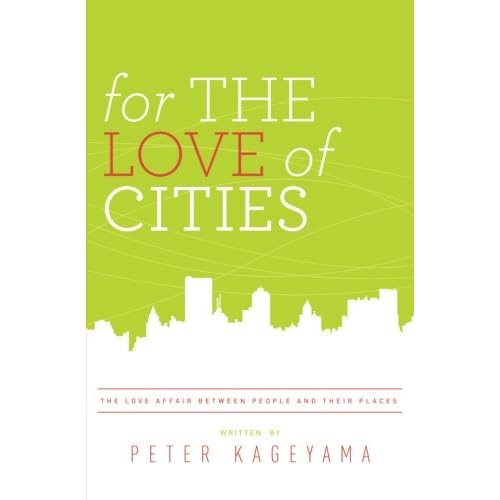
For the Love of Cities: The love affair between people and their places, a new book by urbanist Peter Kageyama, explores the love affair between people and the places they call home.

Kageyama explores the emotional connection between citizens and their cities, honing in on how the human heart plays a role in economic, social adn community development. Drawing on examples from New Orleans, Detroit, and Cleveland, the book includes stories about ordinary people doing extraordinary things in the wake of the vacuum left behind by dwindling public resources.

Kageyama was interviewed today on the Craig Fahle Show (listen here), on WDET.  According to Kageyama, only 1% of the population are true "place lovers";  those who drive the agenda and invest their energies out of a true love of place.

"True love of place is kind of rare. ...  People who love cities are projecting something of themselves into the city. They want to make meaning in the city, and they are also looking at it as a work of art, they are co-creating the city," he told Fahle.

Kageyama will also be present at the Rust Belt Artists Belt III Conference taking place in Detroit April 6.

Friday, October 22, 2010

Detroit: Urban Agriculture Tour

Finished up the Michigan Association of Planning's annual conference today with a great tour, and met some pretty fascinating Detroit people who are doing amazing things,.

Japanese journalists film us touring D-Town farm
In the morning we headed over to D-Town Farm, run by the Detroit Black Food Security Network on land in Detroit's Rouge Park.  The land is  leased from the City of Detroit for $1/year for 10 years.  Our host, Malik Yakini, chairman of the DBFSN as well as a Detroit Charter School principal, gave us a tour and an explanation of the DBFSN as well as the context in which it is doing its work.  The goal of D-Town farm is to create a model for urban agriculture and to achieve food security for Detroit's black population. D-Town sells produce at Eastern Market, other Farmer's markets in the City, and several restaurants.

Yakini says he is unapologetic about the intent of the DBFSN to advance black power and expressed the local grassroots movements' opposition to large-scale urban agriculture within City limits that does not have the interests of the community in mind.  We also discussed food policy issues; Yakini is on the Michigan Food Policy Council and is working to help develop policy within the city and at the state level that will help community-scale urban agriculture.

While we were there, Japanese journalists filmed our tour for a TV station, and a French radio reporter showed up, wanting to interview Yakini, who seemed used to the attention this project and others like it is garnering on the international stage.
Gwen, who came to Earthworks Urban Farm from Nebraska
 through Americorps

EarthWorks Urban Farm
Next we visited Earthworks Urban Farm, a project of the Capuchin monastery in partnership with Gleaners Food Bank, which has been in operation for ten years. Our tour host, Gwen, came to the Farm via an Americorps assignment and has stayed on through the end of this growing season.  She spoke of the need to engage the local African-American community in urban agriculture, noting that the movement is often led by young, white transplants. The Capuchin program trains local neighborhood residents in farming and gardening, and utilizes the produce in the soup kitchen, which serves neighborhood residents in need..

Thursday, October 21, 2010

Planners in Detroit

Art Installation, Powerhouse Project, Hamtramck

Art Installation, Powerhouse Project, Hamtramck
I'm having a GREAT time at the Michigan Association of Planning's annual conference held in Detroit this year. Yesterday I attended a session with Philip Cooley, part owner of Slows Bar b Q  and Corktown booster, on why he came to Detroit and efforts to rebuild the neighborhood and Roosevelt Park at the foot of Detroit's greatest ruin.

This morning we heard from starchitect/star urban planner Toni Griffin and City of Detroit Deputy Planning Director Marja Winters on Detroit's much publicized, philanthropically-funded land use planning process, Detroit Works.

In the afternoon I attended a FANTASTIC tour of the City of Hamtramck, which I had not visited since high school when we hung out at Paychecks lounge.  Who knew- Hamtramck has retained it's density and walkability and is now an urban oasis amid the devastation of the surrounding City of Detroit.

The Polish population that founded the town in the 1920's is still present, comprising about 30-40% of the population, and has been supplemented by hardworking, entrepreneurial immigrants from Bangladesh and other countries.

It is fascinating to see these newcomers repeat the pattern of the Eastern and Southern Europeans of 100 years ago- they first land in New York, then come to Detroit for the cheaper cost of living, and start businesses.  Once they have gained financial stability, some move to the inner-ring suburbs, such as Warren, while others stay in the City.

Highlights of the tour included the Powerhouse Project,  a program to place national artists in residencies within an underserved Hamtramck neighborhood,  the Detroit Zen Center, which has been in existence since the 1990's and is working to create a neighborhood-scale sustainability model, and  the Polish Art Center, a purveyor and teacher of Polish folk art.

Tomorrow I am looking forward to Urban Agriculture Tour.

Saturday, October 9, 2010

Place Samplings 10/9/2010

Better Burb Contest- "The time for thinking cautiously is over"
From the website: 
There has been a crisis of imagination, and your bold new ideas are urgently needed. There should be no preconceptions about what is or is not possible. What would you do on these acres of opportunity? Build a car-free community for thousands? Plant an oasis of urban agriculture? Produce renewable energy and provide well-paying green jobs? Use landscape systems to repair ruptures in regional ecologies? Introduce armatures to enhance public space and the civic realm?


Other Links of Note:

Obama Administration Rolls Out the Neighborhood Revitalization Initiative


Detroit

Monday, October 4, 2010

PlaceLit: Rhonda Welsh

My Only Home

By Rhonda Welsh

Detroit is my only home.
Child of the west side...
Majestic, Puritan, Elmhurst,
Linwood, Plymouth, Eight Mile
All the while
craved a
different existence
but finally realized
Detroit is who I am.
Good students teased for acting too white
while the suburbs scream too black.
Neighborhoods who know no lack
always labeled poor.
Detroit was once much more than…
Dirty streets. Corrupt politicians.
Perverted superstitions
make some people treat books
like bad ju ju.
But my Detroit is not that simple…
Kind-hearted hustlers work day and night.
Make a dollar out of fifteen cents.
The auto industry came and went
but true Detroiters always make it work.
Saturday greens from Eastern Market
and a new hat from Mr. Song.
You can't go wrong on Sunday mornings
shouting and rocking
until the blues melt away.
Detroiters always seek
a brand new day.
Even our skyline boasts a Renaissance.
And the summer…
Caribbean Picnic on Belle Isle,
Moonlit concerts at Campus Martius,
and greasy fish fingers
clap to the beat
with sandal clad feet
at the African World Festival.
Poetry is everywhere.
Music Hall, Scarab Club, 1515 Broadway,
even at the Y-M-C-A.
Detroit is no longer in its heyday,
but its days are not finished yet.
There is much more life.
More pride runs through the veins.
Soon the activists must rise and take the reins.
Restore what has been lost.
No longer give thought
to those who diss and dismiss.
It is not a wasteland.
There are families here.
Educators, doctors, lawyers,
butchers, bakers,
yes, even candlestick makers reside in Detroit.
Shake off depleted self-esteem
that hangs over the city like a cloud.
Shout the city's praises out loud
and recognize its worth.
Induce the new birth.
Invoke that migrant spirit
transplanted from red earth.
Don't let it die an unnatural death.
Purge the dross and rebuild the best.
Detroit is the only home I've ever known.

©Rhonda Welsh 2010
from the book Red Clay Legacy


Read more: http://detroit.blogs.time.com/2010/10/04/a-detroit-poet-and-her-city-as-muse/?utm_source=feedburner&utm_medium=email&utm_campaign=Feed%3A+blogs%2Fthedetroitblog+%28TIME%3A+The+Detroit+Blog%29#ixzz11RTmgfLn

Place Events: 2010 Tour de Troit

The 2010 Tour de Troit (TdT) is now a thing of the past.  In it's ninth year, TdT saw more than 3500 riders converge on Roosevelt Park, at the foot of the Detroit's most famous ruins, the old  Michigan Central Station depot.

My husband and I (along with our friend Rashmi) rode the tour on September 25, which was also our 11th wedding anniversary (that's us at left as we rounded Belle Isle).  The weather was a perfect, crisp 62 degrees, with a mix of sun and clouds, and the pace was slow and leisurely. The tour took us on a 30-mile loop of the City, through Corktown, Downtown Detroit, paralleling the Dequindre Cut, around Belle Isle, through Indian Village, past the Heidelberg project, through Midtown Detroit, TechTown, Mexican Town, and back to Roosevelt Park where local beers and pulled pork from Slows Bar BQ and tamales from Honeybee Market were available for the starving riders.

The event seeks to bring people up-close-and-personal with Detroit's neighborhoods and to promote greenlinks in the City.


2010 Tour Detroit - a set on Flickr

Wednesday, August 25, 2010

Tour De Troit: Biking in the Motor City

Register now for the Tour De Troit, Saturday September 25th.

From the registration page:

Event Details

The Tour de Troit, set for September 25, is a bike ride that explores some of the city’s historic areas, takes in many of its most breathtaking sights, and provides bicyclists a unique opportunity to legally “take over” the streets of Motown. Last year’s ride attracted 2,000 riders!
The Tour de Troit is offering riders two options. The first — and primary — will be a leisurely ride of 30 miles with police escort. The second option, new this year, is intended for extremely experienced cyclists. It is a metric century (62 miles) that will not include police escort. Both rides will be sweeper- and SAG-supported and will begin at 10 a.m. at Roosevelt Park, located at the intersection of Michigan Avenue and 14th Street.
After the ride, there is food, drink and music at Roosevelt Park in the shadow of the Michigan Central Station!


And in the evening head on over to St. Andrew Hall for Built to Spill.  Sounds like a  fun day.

Tour De Troit: Biking in the Motor City

Tuesday, August 24, 2010

Woodward Dream Cruise 2010

Nothing says "Detroit" like the Woodward Dream Cruise. (Thanks to Jessica O. for the pics.)


Saturday, July 31, 2010

The Urbanophile's Detroit Post

The Urbanophile, one of my favorite urban planning blogs, recently re-posted it's most popular post ever.

The post, which ran originally in 2009, is on Detroit, and gives a pretty good synopsis of where things stood in 2009.  I am not sure much has changed since the original post..

All of this national media interest initiated  in 2008 when the national spotlight shone on the collapsing auto-industry. Time's Detroit Blog, Dateline's infamous piece and many other media pieces have put a magnifying glass on the City. The suburbs have escaped notice.

Now two years later, I wonder how long it will last. .

There are some pretty great Detroit bloggers out there.  Here is one of my favorites; I have a feeling this guy will be writing when and if the national spotlights fade:

http://bbandm.wordpress.com/

Tuesday, June 22, 2010

Letter from Detroit


I recently wrote a prose piece, Letter from Detroit, that was accepted for publication in two literary magazines- the online Glass Coin, and the July/August print version of Orion Magazine .

The piece reflects my feelings about my choice to remain in the Detroit Metropolitan area- the beauty and the struggle, the hope and the despair, which is inherent everywhere but is particularly stark in the Detroit area.

You can read my piece here, and submit your own to Orion's the Place Where You Live web feature.

Tuesday, April 27, 2010

Green Detroit: Why the City Is Ground Zero for the Sustainability Movement

This article by Metro Time's founder Ron Williams articulates so much of my hopes for the City of Detroit and my concerns about the "Green" movement:.


Image Credit: shorpy.com

Sunday, April 18, 2010

Michigan Green Leaders

   (Illustration by RICK NEASE/DFP)
Just in time for Earth Day,  Detroit Free Press has a Sunday spread on Michigan Green Leaders, highlighting individuals who are leading the way to a brighter, greener future in the state. I am fortunate to know and work with several of these individuals.  They are all truly visionaries. View a slideshow here.


Image Credit: Detroit Free Press

Friday, April 16, 2010

Obscura Day 2010 on Vimeo


Obscura Day 2010 from Dylan D. Thuras on Vimeo.


Obcura Day, 2010, was a rousing success with 80 events. Detroit's Heidelburg Project was featured, along with other "wonders, curiosities, and esoterica" across the globe. See the atlasobscura website for more info on this event and website's celebration of place.

Saturday, April 10, 2010

Debunking the Mythology


Finally, videos, images and a written summary of the Our Detroit Story conference us available here. Start debunking the myths!

Speaking of mythology, I had never before seen this video, about the mythological Detroit Riots of 1967 which are blamed for initiating the demise of Detroit. Wow. (Thanks Jen.) OK I see what all the Sam Roberts buzz is about. Pretty fascinating imagery mixed in with a solid bluesy song.

And if you really want to dive in deep, come face to face with Detroit as it really is, you can either take the twelve hour tour of the Detroit Orientation Institute, or jump on a Segway tour (I plan to very soon). Both tour are available through Inside Detroit.
Image Credit: The Detroit News Hub

Monday, April 5, 2010

A Ten Year Vision for Detroit

The Freep's Sunday Editorial section featured a spread summarizing various items coming  together to deliver a  "smaller, smarter, greener" city in ten years. Mitch Albom's poetic piece begins:
"In my Detroit, a decade from now, there are no blocks with one burned-out house. Those eyesores have been leveled. Grass and trees have taken their place."
I would have liked to see a few additions to Albom's column and to the featured map (which should not have yellowed out the suburbs and Windsor, Canada.

I would add the following:

In my Detroit, the hundreds of autonomous suburban municipalities and school districts have merged services to become more efficient and effective.


In my Detroit, the City and every suburb have adopted and implemented sustainability plans which outline how they are going to reduce greenhouse gases, conserve water, create and preserve green infrastructure, and reduce solid waste.

In my Detroit, Belle Isle has been restored to its former grandeur, and the Belle Isle Aquarium has been re-opened and expanded, featuring top-notch exhibits and programs about the Great Lakes and the Detroit River.


In my Detroit, the City and suburbs collaborate and cooperate because they know it is in their mutual best interest to do so.

Saturday, March 27, 2010

Downsizing Detroit


Can Detroit be downsized?  Can the vast tracts of land now featuring vacant, abandoned neighborhoods be transformed into orchards, pumpkin patches, cornfields, and vegetable gardens?  Can neighborhoods be consolidated? And will this, in the end, do anything to alleviate the generational poverty that has afflicted the remaining citizens of Detroit since the 1960's?

I am optimistic about this for several reasons:

1. Foundations in the area are coordinating efforts and leveraging resources with an emphasis on Detroit. Kresge Foundation is paying the salary for an outside urban planner to work with City Council to develop the downsizing plan. The foundations have historically worked piecemeal and independently.  This synergy must extend to the public and private sectors in order to avoid the same types of problems that have plagued government-led efforts in the past..

2. Local and organic food is a big deal. Even mid-level chain grocery stores such as Kroger are advertising sourcing of local products.  Done right,  there is unprecedented potential for local agriculture to be profitable.

3. Unlike earlier economic development schemes (think: casinos) the concepts of downsizing and urban farming are not designed to create thousands of jobs and enrich investors and developers.  Instead, downsizing is a rational response to existing conditions, and urban agriculture identifies a viable use for the city's main asset: land. No one will get rich, but maybe a stable and productive industry will lift some out of poverty. And unlike gambling, there is no societal cost to community gardens.

Friday, March 19, 2010

Edible Wow Spring 2010

New issue out!  This edition contains an in inspiring piece about Peaches & Greens,  an effort to sell fresh produce in the style of an ice-cream truck to the poorest neighborhoods in Detroit's food desert.

If you don't subscribe, you will have to find your issue at one of the magazine's advertiser's locations. I found mine at Mind,  Body, Spirits in Rochester, an upscale sustainable, organic eatery with a LEED-certified building featuring, among many other features,  geothermal heating/cooling, an onsite greenhouse, and a food composter.

Wednesday, March 3, 2010

Culture in the D

A great deal of press lately has focused on Detroit art, DIY and "homepreneurs." Detroit is wrapping up it's first Indie Film Fest this week. We are hosts to one of several Moth events across the nation. Last month saw the freezing (and thawing) of the Ice House project. The Heidelburg Project (above photo) is alive and well after 20+ years, and is hosting an "outsider art tour" on March 20th, which is Atlas Obscura day (see previous post). Matrix Theater is building community through theater in southwest Detroit. The Crofoot in Pontiac continues to put out a can't miss schedule of concerts showcasing local and national talent. Live jazz can be had at Cliff Bell's. The Scarab Club continues to present art, music and literature after 100 years. And of course, the DIA and Detroit Film Theater continue to bring art and culture to the region.

When you read about Detroit in the national media, you don't often hear about this stuff: the people and institutions that sustain a vibrant culture, and which give soul and authenticity to this place, in times of good and in times of difficulty.